Siegfried Royal Opera House
★★★★★
Wagner’s Der Ring des Nibelungen – four operas together lasting 16 hours – defies neat theoretical analysis. You could spend a lifetime studying it from a hard-left Marxist perspective, or from a contemplative Buddhist one, and still be all at sea.
But as director Barrie Kosky pointed out when launching his four-part Covent Garden Ring three years ago, it can also be read as a terrifying parable for the end of our world. ‘The earth will expire in a Wagnerian apocalypse of fire and water,’ he declared. ‘It’s going to burn, and then flood.’ He wanted to strip the story back to the quintessential human predicament.
And his heretical trump card in Rheingold lay in his insertion of a new non-singing character: he placed the action under the remains of a smoke-blackened tree, round which a naked and very old woman prowled silently.
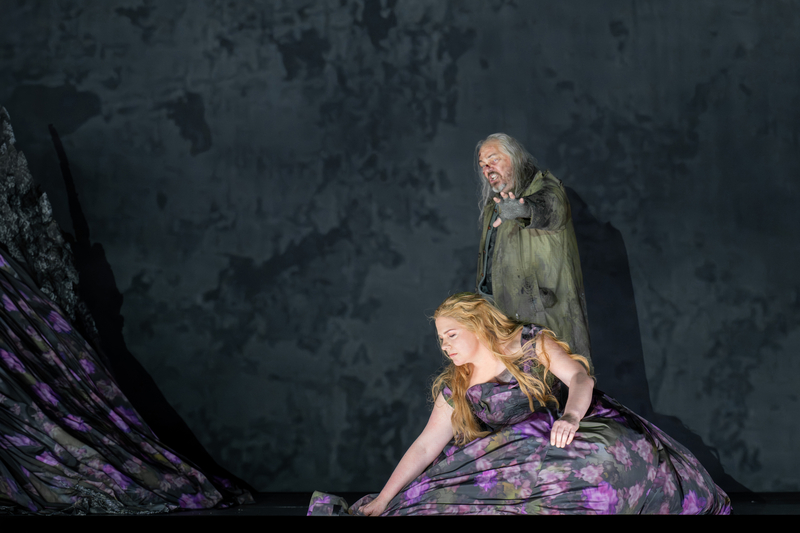 Wiebke Lehmkuhl as Erda and Christopher Maltman as Der Wanderer in Siegfried, ROH © Monika Rittershaus
Kosky and his designer Rufus Didwiszus have now unveiled their take on Siegfried, much of which necessarily consists of long and intricate dialogues, but Kosky’s visual imagination has been liberated from the unchangingly bleak landscape of his Rheingold. Act one takes place in what looks like a run-down prison-camp, while Act 2 takes place in a charmingly delineated snowy forest, and the third act unfolds in an Eden bursting with flowers in which the protagonists become Adam and Eve. Meanwhile Wiebke Lehmkul’s Erda dreams the fate of our despoiled, doomed earth. And the naked woman – still silent – now becomes a player in the drama, interacting with each character in turn.
And the cast is terrific. Christopher Purves makes a grimly effective Alberich, Peter Hoare’s Mime infuses the plot with a thread of crazy hyperactivity, and Christopher Maltman’s Wanderer firmly grounds the action, thanks to the authority and sheer beauty of his sound. It’s no surprise to learn that he and Kosky agreed that this wanderer is also the one from Schubert’s Winterreise. It’s not just about the desperation of being lost: it’s the whole gamut of emotional colour which the charismatic Maltman so skilfully evokes. With this definitive performance, he’s hit a personal high.
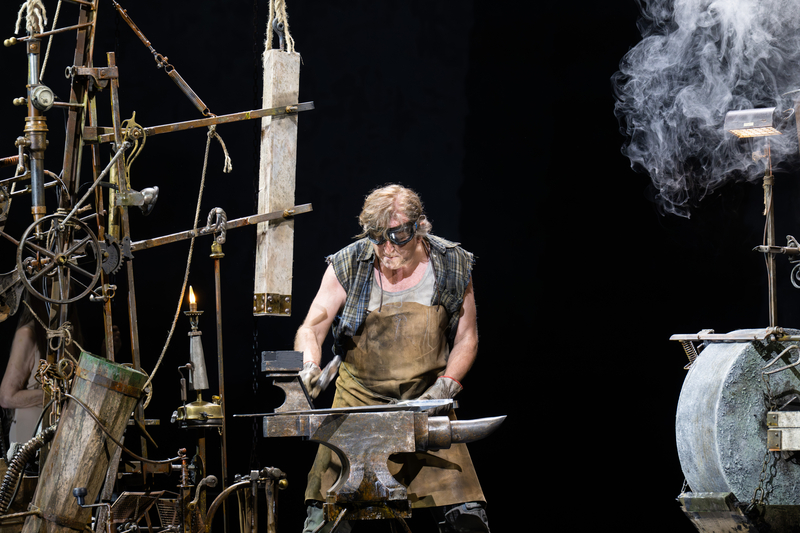 Andreas Schager as Siegfried, ROH © Monika Rittershaus
And with Andreas Schager in the title role, where to begin? As the late Michael Tanner once pointed out, this eponymous hero who knows no fear must forge a sword, kill a dragon, shatter Wotan’s spear, and walk through a wall of fire to awaken a sleeping goddess. Siegfried can do anything, but he’s an unspoiled child of nature, and this part of the Ring follows his lessons in life, and his quest for identity.
Schager, a live-wire presence, takes all this in his stride, purveying comedy, bewilderment, pathos, and an irrepressible physical energy, as he powers the drama to its triumphant close. And if the staging of that close has a whiff of crowd-pleasing Fifties Hollywood, so what?
Elisabet Strid’s Brünnhilde has a sweetly girlish quality, which clearly delighted the crowd at Covent Garden on first night. It was appropriate that Antonio Pappano should get as big a roar, because he and his band turn the evening into a thrilling display of instrumental brilliance.